
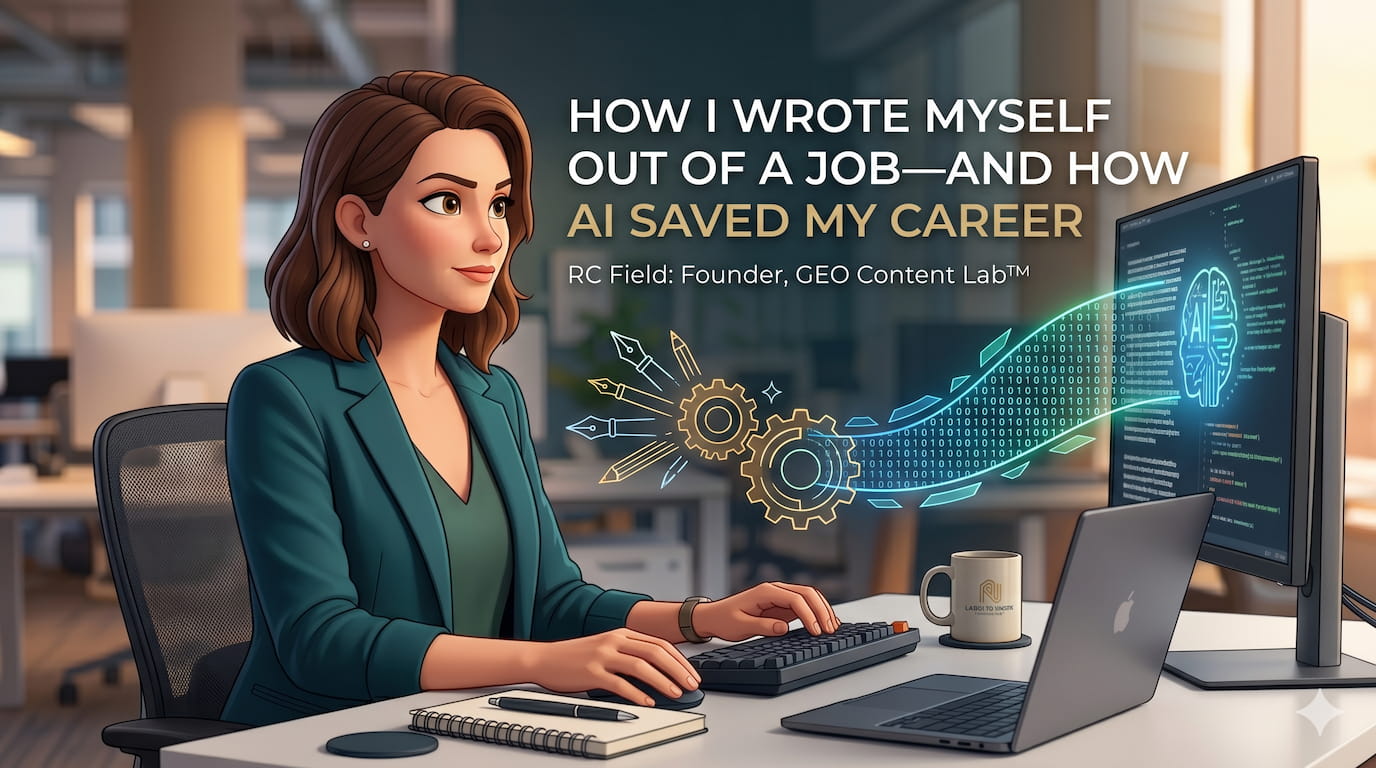
Before I went freelance, I was a corporate ladder climber.
I started in a call center exactly two days after college graduation. Spent years bouncing between office roles. Through all of it, I was a writer. I always had a side hustle, a blog, something. But I never thought a “real” company would pay me to write. I figured corporate writing was for people with fancy degrees. I didn’t think I was good enough.
The “Number One” Opportunity
Everything changed when I landed a role at the country’s premier e-commerce powerhouse. Before the giants like Shopee and Lazada arrived to split the crown, this company was the absolute blueprint. They were the ‘it’ place—the unbeatable standard for the entire industry.
Here’s the embarrassing truth: I didn’t even know what the job was.
In the interview, I told the recruiter exactly that. I said I wasn’t sure what they needed, but I was ready to learn. He didn’t roll his eyes. He looked at my blog, the one I’d added to my resume on a whim, and he liked what he saw. He sent me to the editorial team for a test.
I passed. Just like that, I had my first real job as a writer.
The System That Worked Too Well
I stayed for almost three years. Got promoted to Editor. Built a team I actually liked.
Then the layoffs started. Ten people gone. Then more. The message was clear: if your job could be done cheaper or faster, you were next. I wanted to protect my team. So I built a system. A fill-in-the-blanks content template that lets us produce high-quality work in a fraction of the time. It worked exactly like a modern AI prompt, before I even knew what that was.
I thought I was saving us. I wasn’t.
The system worked so well that the company decided they didn’t need an editorial team at all. Within a week, we were all gone. I had future-proofed the company. I just forgot to do the same for myself.
Adapting to the AI Revolution
I didn’t walk into AI. I was pushed.
Years later, I landed a role where my previous boss introduced me to it. He showed me how AI content generation worked, what it could do, and why it mattered. I didn’t ask for that education. But I got it anyway.
At the time, I was still a writing purist. I believed in the craft. Clean sentences, real research, human voice. Then AI started eating the jobs I was good at. Writers on the team were let go. Others quit. Nobody replaced them. Slowly, I became the only one left holding it all together.
So I learned. Not because I wanted to. Because I had no choice. I kept doing what my boss taught me. I didn’t even know what it was called. I just thought it was part of SEO.
Then I left that job. And the market humbled me fast.
Writer jobs were paying less than ever. Copywriting didn’t interest me. I’m not a book author or a scriptwriter. Web content is where I actually shine and I enjoy it. But those roles were being lowballed like crazy. I was too broke to pay for AI courses. Too experienced to start over. Too specific in my skills to just pivot anywhere.
So I did the only thing I could. I researched. Hard.
I went back to everything my boss had taught me and started pulling threads. That’s when it clicked. The work I had already been doing, the thing I had quietly gotten good at, had a name: Generative Engine Optimization (GEO).
And that’s where the obsession started.
I didn’t ease into it like someone learning something new. I moved into it like someone who had been doing it without realizing it. I went from writer to AI specialist, not because it was trendy, but because I knew what happened to people who waited. I had already lived that story twice.
The GEO Advantage: From Obsolete to Indispensable
I’ve lived the story of being replaced by a system twice. Once by a template I built myself, and once by the silent creep of automation. I know the gut punch of realizing your hard-earned skills are being “lowballed” by a market that values speed over soul.
But here is the truth I found in the data: AI isn’t the enemy that takes the job; it’s the engine that amplifies the authority.
Ranking on page one isn’t enough anymore. AI engines like Gemini, Perplexity, and ChatGPT are becoming the primary gatekeepers of information. They provide the answer before a user ever clicks a link. The question is no longer “Can Google find me?” It is “Will AI cite me, summarize me, and recommend me?”
This is why I built GEO Content Lab™.
I’ve combined two decades of editorial discipline with the technical precision of Generative Engine Optimization. Whether you’re an agency looking to scale, a professional needing to future-proof your presence, or an SEO expert ready to bridge the gap between human craft and machine logic, I’m here to help you navigate this shift.
Don’t wait to be pushed into the future. Let’s make sure your brand is the answer AI gives, not the one it skips. Contact me today.
About the Author
RC Field is the founder of GEO Content Lab™, a Senior Editorial Strategist and AI Operations Specialist with over 20 years of experience. A veteran of the high-volume editorial world, she has authored and overseen more than 10,000 articles—including 5,000+ written before the age of AI. Today, she combines that deep-rooted craftsmanship with advanced AI workflows to help businesses build content that doesn’t just rank on Google, but is cited, summarized, and recommended by AI engines like Gemini, Perplexity, and ChatGPT.